
I still remember the first time a fraction made me freeze. The worksheet had 3/4 + 2/3 at the top, and I added the tops and the bottoms like it was nothing: 5/7. Wrong, and I had no idea why. That small mistake is the reason I now explain this topic the way I wish someone had explained it to me, with pizza slices, measuring cups, and numbers you can check yourself.
This guide walks you through what fractions mean, the main types, how to simplify and compare, how to add, subtract, multiply, and divide, and how to switch between decimals and percentages. Every method has a worked example, and you can check any answer with a free online fraction calculator.
What Is a Fraction?
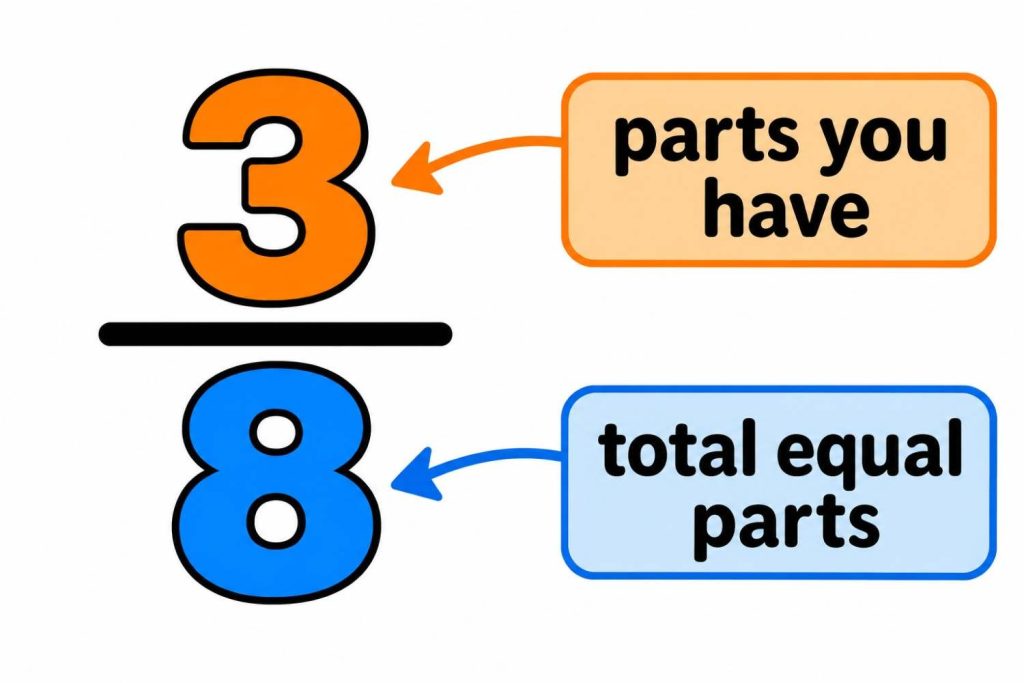
A fraction is a number that shows part of a whole. It is written as one number over another, separated by a line, like 3/4. The top number counts the parts you have. The bottom number tells you how many equal parts the whole was cut into.

Understanding the Numerator and Denominator
The top number is the numerator. The bottom number is the denominator. In 5/8, the numerator 5 says you have five pieces, and the denominator 8 says the whole was split into eight equal pieces.
A simple memory trick: denominator starts with “d,” like “down.” It sits at the bottom. One rule never changes: the denominator can never be zero, because you cannot split something into zero parts.
How Fractions Represent Parts of a Whole?
Picture a pizza cut into 8 equal slices. If you eat 3 slices, you ate 3/8 of the pizza. The 5 slices left are 5/8, and together they make 8/8, which is one whole pizza.
The same idea works with money. A quarter is 1/4 of a dollar, which is 25 cents. A fraction is also a division problem in disguise: 3/4 means 3 ÷ 4, which equals 0.75. The key word is “equal.” If the slices are not the same size, the fraction does not work.
How to Read and Write Fractions?
You read the top number as a regular number and the bottom number as an ordinal:
- 1/2 is “one half”
- 1/3 is “one third”
- 1/4 is “one fourth” or “one quarter”
- 3/5 is “three fifths”
- 7/10 is “seven tenths”
On a keyboard you write a fraction with a slash, like 3/4. On paper, you stack the numbers with a bar between them. Both mean exactly the same thing.
Simple Fraction Examples
Finding a fraction of a number is the first skill that makes the idea feel real.
- 1/2 of 12: 12 ÷ 2 = 6
- 1/4 of 20: 20 ÷ 4 = 5
- 3/5 of 10: divide by the denominator, 10 ÷ 5 = 2, then multiply by the numerator, 2 × 3 = 6
Divide by the bottom, multiply by the top. That one habit solves most beginner problems.
What Are the Different Types of Fractions?
There are six types you will meet again and again. Some describe the size of a fraction, and others describe how two fractions relate to each other.
| Type | Example | Quick rule |
|---|---|---|
| Proper | 2/5 | Numerator is smaller than denominator |
| Improper | 7/4 | Numerator is equal to or bigger than denominator |
| Mixed number | 1 3/4 | A whole number plus a fraction |
| Unit | 1/8 | Numerator is 1 |
| Like | 2/9 and 5/9 | Same denominator |
| Equivalent | 1/2 and 2/4 | Different look, same value |
Proper Fractions
A proper fraction is smaller than one whole. The numerator is less than the denominator, as in 2/5 or 7/9. If you ate 2 slices of a 5-slice pie, you ate a proper fraction of it.
Improper Fractions
An improper fraction is equal to or bigger than one whole. The numerator is the same as or larger than the denominator, as in 7/4 or 9/5. It is not “wrong,” just a different form. 7/4 equals 1.75.
Mixed Numbers (Mixed Fractions)
A mixed number pairs a whole number with a proper fraction, like 1 3/4. To turn it into an improper fraction, multiply the whole number by the denominator and add the numerator: 1 × 4 + 3 = 7, so 1 3/4 = 7/4. To go back, divide: 7 ÷ 4 = 1 remainder 3, so it is 1 3/4 again.
Unit Fractions
A unit fraction has 1 on top, like 1/2, 1/6, or 1/10. Every other fraction can be built from them. Three slices of an eighth-sized piece, for example, is 3 × 1/8 = 3/8. A bigger denominator means a smaller piece, so 1/10 is smaller than 1/2.
Like and Unlike Fractions
Like fractions share a denominator, such as 2/9 and 5/9. You can add or compare them straight away. Unlike fractions have different denominators, such as 1/3 and 1/4, so you need to rewrite them first. That step is where most mistakes happen.
Equivalent Fractions
Equivalent fractions look different but have the same value: 1/2, 2/4, and 4/8 are all half. Cut a sandwich into 2 pieces or 8 pieces, and half is still half.
How to Simplify and Compare Fractions?
Simplifying and comparing fractions are the two skills that make every operation easier later.
Finding Equivalent Fractions
Multiply or divide the top and bottom by the same number. Take 2/3:
- 2/3 × 2/2 = 4/6
- 2/3 × 3/3 = 6/9
You are multiplying by 2/2 or 3/3, which both equal 1, so the value stays the same.
Simplifying Fractions to Their Lowest Terms
A fraction is in lowest terms when the top and bottom share no common factor except 1. To simplify 18/24, divide both by the greatest common factor, which is 6: 18 ÷ 6 = 3 and 24 ÷ 6 = 4. The answer is 3/4.
If you cannot spot the greatest common factor, divide by any shared number and repeat: 18/24 becomes 9/12, then 3/4. You get the same result in two steps.
Comparing Fractions With Different Denominators
Compare 3/4 and 5/8. Rewrite both with a common denominator of 8: 3/4 = 6/8. Now compare 6/8 with 5/8. Since 6 is bigger than 5, 3/4 is greater than 5/8.
There is also a shortcut called cross-multiplying. To compare 2/3 and 3/5, multiply diagonally: 2 × 5 = 10 and 3 × 3 = 9. The side with 10 wins, so 2/3 is larger.
Ordering Fractions From Smallest to Largest
Put 1/2, 3/8, 2/3, and 1/4 in order. The least common denominator is 24:
- 1/2 = 12/24
- 3/8 = 9/24
- 2/3 = 16/24
- 1/4 = 6/24
From smallest to largest: 1/4, 3/8, 1/2, 2/3.
How to Perform the Four Operations With Fractions?
Each of the four operations has its own rule for fractions. Learn them one at a time.
How to Add Fractions?
With the same denominator, add the tops and keep the bottom: 2/7 + 3/7 = 5/7.
With different denominators, find a common denominator first. For 1/4 + 1/6, the common denominator is 12: 3/12 + 2/12 = 5/12.
Now back to my old worksheet. For 3/4 + 2/3, the common denominator is 12, so 9/12 + 8/12 = 17/12, which is 1 5/12. My early answer of 5/7 was less than 1 whole, which should have warned me, because both pieces were already large.
How to Subtract Fractions?
Use the same method as adding. For 3/4 − 1/3, rewrite over 12: 9/12 − 4/12 = 5/12.
How to Multiply Fractions?
Multiply top by top and bottom by bottom. 2/3 × 3/5 = 6/15, which simplifies to 2/5.
You can save time by cancelling first. In 2/3 × 3/5, the 3 on top and the 3 on bottom cancel, leaving 2/5 straight away.
How to Divide Fractions?
Keep the first fraction, change ÷ to ×, and flip the second fraction. For 3/4 ÷ 1/2, that becomes 3/4 × 2/1 = 6/4, which simplifies to 3/2, or 1 1/2.
Solving Fraction Problems With Examples
Example 1, scaling a recipe. A cookie recipe needs 3/4 cup of sugar, and you want to make half the batch. Multiply: 3/4 × 1/2 = 3/8 cup.
Example 2, adding distance. You walk 2/3 of a mile in the morning and 3/4 of a mile in the evening. Add: 8/12 + 9/12 = 17/12 = 1 5/12 miles.
Example 3, cutting ribbon. A ribbon is 5/6 of a yard long, and you cut off 1/3 of a yard. Subtract: 5/6 − 2/6 = 3/6 = 1/2 yard left.
Fractions, Decimals, and Percentages: What’s the Difference?
Fractions, decimals, and percentages are three ways to write the same amount. A fraction shows an exact ratio, a decimal fits calculators and place value, and a percentage shows the amount out of 100, which makes it easy to compare.
How to Convert Fractions Into Decimals
Divide the numerator by the denominator. 3/4 is 3 ÷ 4 = 0.75. Some results repeat forever: 1/3 = 0.333…, which we usually round to 0.33.
How to Convert Decimals Into Fractions?
Write the decimal over a power of 10, then simplify. 0.6 = 6/10 = 3/5. And 0.125 = 125/1000 = 1/8.
How to Convert Fractions Into Percentages?
Turn it into a decimal, then multiply by 100. 3/8 = 0.375, and 0.375 × 100 = 37.5%. You can check the answer with a percentage calculator.
Understanding Fractions, Decimals, and Percentages Through Examples
| Fraction | Decimal | Percentage |
|---|---|---|
| 1/2 | 0.5 | 50% |
| 1/4 | 0.25 | 25% |
| 3/4 | 0.75 | 75% |
| 1/5 | 0.2 | 20% |
| 1/8 | 0.125 | 12.5% |
| 2/3 | 0.667 | 66.7% |
A test score shows how they connect: 18 out of 20 is 18/20, which simplifies to 9/10, which is 0.9, which is 90%.
Where Are Fractions Used in Everyday Life?
You use fractions far more than you notice.
Fractions in Cooking and Measurements
Recipes run on 1/2 cup, 1/4 teaspoon, and 3/4 stick of butter. Doubling 3/4 teaspoon of salt gives 1 1/2 teaspoons. A tape measure is all fractions too: 5/8 inch, 3/16 inch, and so on.
Fractions in Shopping and Money
“One third off” a $60 jacket means $20 off, so you pay $40. A 25% discount is the same as 1/4 off. Coins are fractions of a dollar: a quarter is 1/4 and a half dollar is 1/2.
Fractions in Time and Distance
Fifteen minutes is 1/4 of an hour, and 45 minutes is 3/4 of an hour. If you have driven 1/4 of a 60-mile trip, you have covered 15 miles.
Fractions in Education and Daily Calculations
Grades, probability, and gas gauges all depend on them. The chance of rolling a 4 on a standard die is 1/6. A tank at 3/8 full tells you it is time to stop for fuel.
What Is the Best Order to Learn Fractions?
When I teach this to someone new, I follow the same path every time, because each step quietly prepares the next.
Start With Basic Fraction Concepts
Learn what the numerator and denominator mean. Draw pizzas, bars, or circles until the picture feels natural.
Learn Different Types of Fractions
Get comfortable with proper, improper, and mixed numbers, and practice switching between the last two.
Practice Simplifying and Comparing Fractions
Equivalent fractions and lowest terms come next. Almost every operation depends on them.
Move on to Fraction Operations
Start with adding and subtracting like fractions, then unlike ones. Multiplying and dividing come after, and many learners find those two easier than adding.
Practice With Real-World Fraction Problems
Finish with recipes, discounts, and distances. Word problems show whether you truly understand or only memorized rules.
How to Use a Fraction Calculator?
A fraction calculator is a helpful checker, not a replacement for understanding. I always solve a problem by hand first, then confirm it with the tool. The CalcSolver Guide shows how to use each CalcSolver tool, step by step.
Entering Fractions Into the Calculator
Type the numerator, then the fraction bar, then the denominator. For a mixed number like 1 3/4, enter the whole number first, then the fraction part. Check the screen before you press equals, because one wrong digit changes everything.
Performing Basic Fraction Operations
Enter the first fraction, pick the operation (+, −, ×, or ÷), then enter the second fraction. Try 2/3 × 3/5 and you should see 2/5, the same answer we worked out above.
Simplifying Fraction Results
Most calculators reduce the answer to lowest terms automatically and can show it as both an improper fraction and a mixed number. If your answer is 6/15 and the tool shows 2/5, that is the simplified form.
When to Use an Online Fraction Calculator?
Use it to check homework, scale a recipe quickly, or handle awkward denominators like 7/12 + 5/18. Use your own head when you are learning, so the skill stays yours.
Frequently Asked Question
What is a fraction in simple words?
A fraction is a way to show part of a whole. If you cut a cake into 4 equal slices and take 1, you have 1/4 of the cake.
What are the four main types of fractions?
Most lessons start with proper, improper, mixed, and unit fractions. Like, unlike, and equivalent fractions describe how fractions relate to each other.
What is the difference between a numerator and denominator?
The numerator is the top number and counts the parts you have. The denominator is the bottom number and shows how many equal parts make the whole.
How do you simplify a fraction?
Divide the top and bottom by their greatest common factor. For 12/18, the factor is 6, so the answer is 2/3.
How do you find equivalent fractions?
Multiply or divide the numerator and denominator by the same non-zero number. For example, 3/5 × 2/2 = 6/10.
How do you add fractions with different denominators?
Find a common denominator, rewrite each fraction, then add the numerators. For 1/2 + 1/3, use 6: 3/6 + 2/6 = 5/6.
Can a fraction be greater than 1?
Yes. When the numerator is bigger than the denominator, as in 9/4, the fraction is greater than 1. You can also write it as the mixed number 2 1/4.
What is the easiest way to learn fractions?
Start with pictures, then learn the types, then simplifying, and only then the four operations. Short daily practice with real examples beats one long session.