
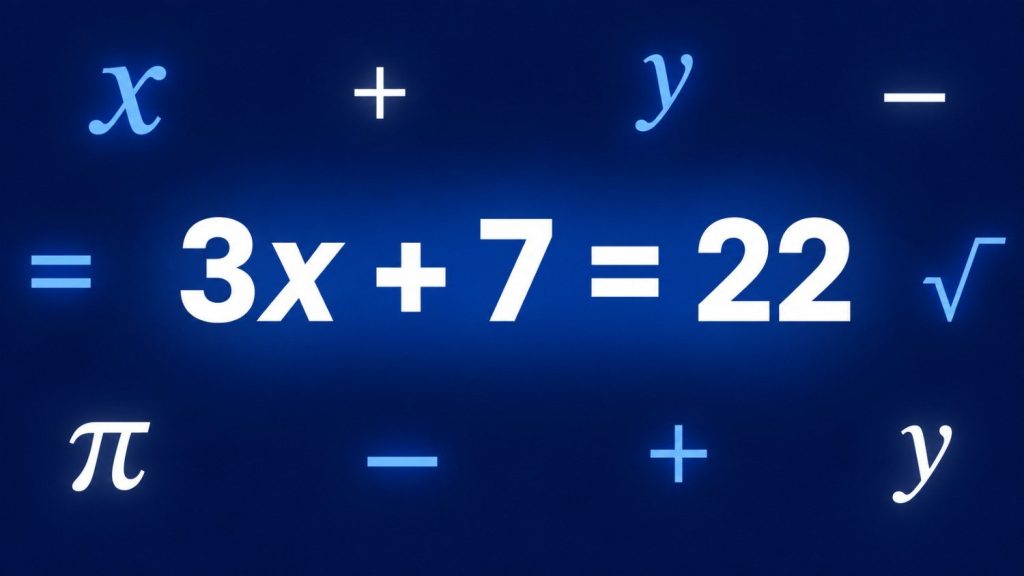
I still remember the afternoon algebra stopped scaring me. I was staring at 3x + 7 = 22, convinced the letter x was a trick. My teacher tapped the page and said, “It’s just a number wearing a mask.” That one line did more for me than a whole chapter of rules.
This guide is what I wish I had back then. It covers the basics, the formulas worth memorizing, every major type of equation, and solved examples you can follow line by line. I have used each method here on real homework, in tutoring sessions, and on everyday problems like phone plans and discounts, so I will tell you where people usually slip, not just what the textbook says.
What Is Algebra?
Algebra is the branch of mathematics that uses letters, called variables, to stand for unknown or changing numbers. It lets you write a rule once and use it for any value, then solve for the unknown by keeping both sides of an equation balanced.
Understanding the Basics of Algebra
The word comes from “al-jabr,” a term from the book written around 820 CE by the Persian mathematician Muhammad ibn Musa al-Khwarizmi in Baghdad. Al-jabr meant restoring or balancing, and that is still the heart of solving equations. Centuries later, René Descartes helped make x, y, and z the standard letters for unknowns, and Robert Recorde gave us the equals sign in 1557.
In my own words: algebra is arithmetic with a placeholder. If 4 + __ = 11, you already know the blank is 7. Write it as 4 + x = 11 and you have done algebra.
Variables, Constants, Coefficients, and Terms
Take the expression 5x + 3. Here is how each piece is named:
| Part | What it is | In 5x + 3 |
| Variable | A letter standing for an unknown number | x |
| Constant | A fixed number that never changes | 3 |
| Coefficient | The number multiplied by a variable | 5 |
| Term | One piece of an expression, split by + or − | 5x and 3 |
Algebraic Expressions vs. Algebraic Equations
An algebraic expression has no equals sign, like 3x + 5. You can simplify it, but you cannot solve it. An algebraic equation has an equals sign, like 3x + 5 = 20, and you can solve it to find x (here, x = 5). Students mix these up all the time, and it costs them points on tests.
Algebra vs. Arithmetic: What’s the Difference?
Arithmetic works with specific numbers and gives one answer. Algebra works with variables and describes a pattern that holds for many values.
| Arithmetic | Algebra | |
| Uses | Known numbers | Variables for unknown numbers |
| Typical question | What is 4 + 7? | If x + 7 = 11, what is x? |
| Result | One value | A value or a general rule |
Every algebra step is still arithmetic underneath. Once you see that, the subject feels much smaller.
Why Is Learning Algebra Important?
Algebra trains one skill that shows up everywhere: turn a real situation into an equation, then work backward to the unknown. School spends years on it because that habit transfers to almost every job and decision involving numbers.
Practical Uses of Algebra in Everyday Life
- Shopping: A 25% discount on a $80 jacket is 80 − 0.25(80), which gives $60.
- Saving: If you save $40 a week toward a $600 goal, 40w = 600 tells you it takes 15 weeks.
- Travel: Distance = speed × time. Know two, solve for the third.
- Phone plans: Plan A costs $10 plus $2 per GB. Plan B is a flat $25. Setting 10 + 2g = 25 shows they cost the same at 7.5 GB.
How Algebra Helps in Science, Technology, and Finance?
Physics formulas such as F = ma and v = d/t are algebra equations. Programmers use the same logic when they write a formula inside a function. In finance, simple interest I = Prt and loan comparisons are solved the same way. If you plan to study calculus, statistics, or computer science, algebra is the entry ticket.
Key Algebra Vocabulary, Signs, and Symbols
A lot of confusion comes from not knowing the words, not from the math itself. Learn the vocabulary first and everything after it moves faster.
Common Algebra Terms and Their Meanings
| Term | Meaning | Example |
| Variable | Letter for an unknown | x |
| Constant | Fixed number | 7 |
| Coefficient | Number attached to a variable | 4 in 4x |
| Expression | Terms with no equals sign | 2x + 9 |
| Equation | Two expressions set equal | 2x + 9 = 15 |
| Polynomial | Expression with several terms and whole-number exponents | x² + 3x − 4 |
| Inequality | Compares with <, >, ≤, or ≥ | 2x + 3 > 11 |
Algebra Signs and Mathematical Symbols
| Symbol | Meaning |
| = | Equals |
| ≠ | Not equal to |
| < and > | Less than, greater than |
| ≤ and ≥ | Less than or equal to, greater than or equal to |
| ± | Plus or minus (two answers) |
| √ | Square root |
| ( ) | Do this part first |
Like and Unlike Terms
Like terms have the same variable raised to the same power. 4x and 9x are like terms, so 4x + 9x = 13x. 4x and 4x² are unlike terms, because the exponents differ, so they cannot be combined. I have seen this single idea cause more wrong answers than any formula.
Basic Rules and Concepts of Algebra
Order of Operations (PEMDAS)
Solve in this order: Parentheses, Exponents, Multiplication and Division (left to right), then Addition and Subtraction (left to right). Some schools teach BODMAS, which is the same rule with different letters.
Example: 3 + 2 × (4 + 1)². Parentheses first: 4 + 1 = 5. Exponent: 5² = 25. Multiply: 2 × 25 = 50. Add: 3 + 50 = 53.
Combining Like Terms
Add or subtract the coefficients and keep the variable part. 6y + 2y − 5y = 3y. Constants combine with constants only.
Simplifying Algebraic Expressions
Simplifying means rewriting an expression in its shortest form without changing its value. Distribute, combine like terms, and remove extra parentheses. For 2(x + 4) + 3x, distribute to get 2x + 8 + 3x, then combine to get 5x + 8.
Distributive, Commutative, and Associative Properties
- Distributive: a(b + c) = ab + ac
- Commutative: a + b = b + a and a × b = b × a (order does not matter for addition and multiplication, but it does for subtraction and division)
- Associative: (a + b) + c = a + (b + c) (grouping does not matter)
Different Types of Algebraic Equations
Recognizing the type tells you which method to use.
Linear Equations
The variable has an exponent of 1, like 3x + 5 = 20. You isolate x with inverse operations and get one solution.
Quadratic Equations
The highest exponent is 2, like x² − 5x + 6 = 0. You can factor, complete the square, or use the quadratic formula. Expect up to two solutions.
Polynomial Equations
Any equation built from a polynomial, such as x³ − 4x = 0. Factor it as x(x − 2)(x + 2) = 0 and the solutions are x = 0, 2, and −2.
Rational and Radical Equations
A rational equation has a variable in a denominator, like 6/x = 3, which gives x = 2. A radical equation has a variable under a root, like √x = 5, which gives x = 25. With radicals, always plug the answer back in, because squaring both sides can create false solutions.
Algebraic Inequalities
Solve them like equations, with one big exception: flip the sign when you multiply or divide by a negative. For −2x > 8, dividing by −2 gives x < −4.
How to Solve Algebraic Equations Step by Step?
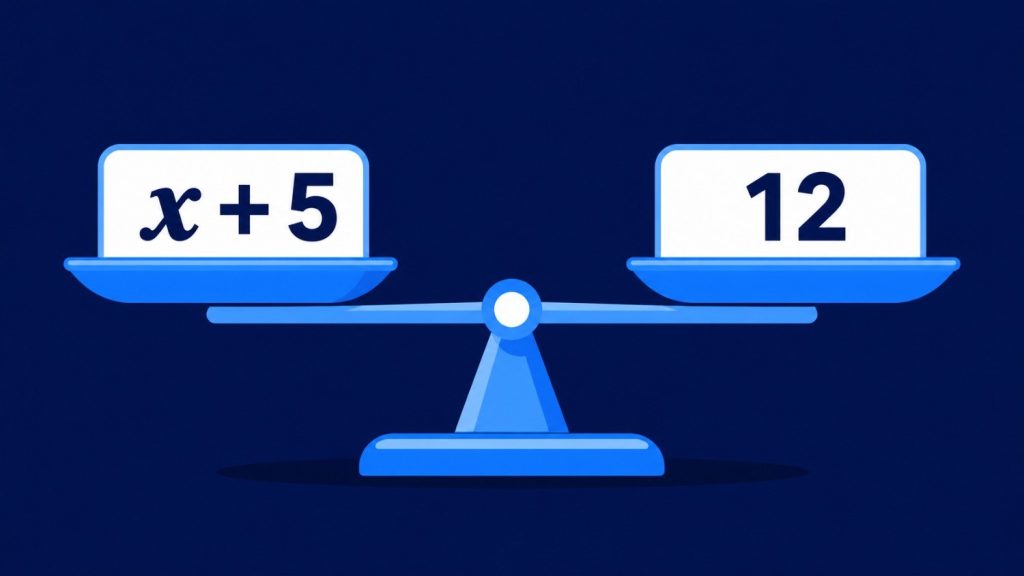
The method never changes: whatever you do to one side, do to the other. Undo addition with subtraction, and undo multiplication with division, working backward through the order of operations.
Solving One-Step Equations
Solve x + 12 = 31.
Subtract 12 from both sides: x = 19.
Solving Two-Step Equations
Solve 4x − 7 = 21.
Add 7 to both sides: 4x = 28. Divide both sides by 4: x = 7.
Solving Multi-Step Equations
Solve 3(x + 2) − 5 = 2x + 9.
Distribute: 3x + 6 − 5 = 2x + 9. Combine like terms: 3x + 1 = 2x + 9. Subtract 2x: x + 1 = 9. Subtract 1: x = 8.
Solving Equations with Variables on Both Sides
Solve 7x − 3 = 4x + 18.
Subtract 4x from both sides: 3x − 3 = 18. Add 3: 3x = 21. Divide by 3: x = 7. Always move the smaller variable term so you avoid negatives.
How to Check Your Algebra Answers?
Put your answer back into the original equation. For x = 7 in 7x − 3 = 4x + 18: left side is 49 − 3 = 46, right side is 28 + 18 = 46. They match, so the answer is right. This ten-second habit has saved me from more mistakes than anything else.
Essential Algebra Formulas and Rules Cheat Sheet
These are the formulas I reach for again and again. Bookmark this section.
Basic Algebra Formulas
| Formula | Used for |
| x = −b / a | Solving ax + b = 0 |
| y = mx + b | Line (m = slope, b = y-intercept) |
| m = (y₂ − y₁) / (x₂ − x₁) | Slope between two points |
| (a + b)² = a² + 2ab + b² | Squaring a binomial |
| I = Prt | Simple interest |
Exponent Rules and Laws
| Rule | Example |
| aᵐ · aⁿ = aᵐ⁺ⁿ | 2³ · 2⁴ = 2⁷ = 128 |
| aᵐ / aⁿ = aᵐ⁻ⁿ | 5⁶ / 5⁴ = 5² = 25 |
| (aᵐ)ⁿ = aᵐⁿ | (3²)³ = 3⁶ = 729 |
| a⁰ = 1 | 9⁰ = 1 |
| a⁻ⁿ = 1 / aⁿ | 2⁻³ = 1/8 |
Common Factoring Identities
| Identity | Factored or expanded form |
| a² − b² | (a + b)(a − b) |
| (a + b)² | a² + 2ab + b² |
| (a − b)² | a² − 2ab + b² |
| a³ + b³ | (a + b)(a² − ab + b²) |
| a³ − b³ | (a − b)(a² + ab + b²) |
The Quadratic Formula
For ax² + bx + c = 0:
x = (−b ± √(b² − 4ac)) / 2a
The part under the root, b² − 4ac, is the discriminant. If it is positive, you get two real solutions. If it is zero, you get one. If it is negative, there is no real solution.
Logarithm Rules and Properties
- log(xy) = log x + log y
- log(x/y) = log x − log y
- log(xⁿ) = n · log x
- log_b(x) = ln(x) / ln(b), the change of base rule
Arithmetic and Geometric Sequence Formulas
- Arithmetic (add the same number d each time): aₙ = a₁ + (n − 1)d, and the sum Sₙ = n/2 · (a₁ + aₙ)
- Geometric (multiply by the same ratio r each time): aₙ = a₁ · rⁿ⁻¹, and the sum Sₙ = a₁(1 − rⁿ) / (1 − r) when r ≠ 1
How to Solve Algebra Word Problems?
Word problems are hard because of translation, not math. Once the sentence becomes an equation, you already know what to do.
Identify Variables and Important Information
Underline the question and the numbers. Decide what the unknown is and give it a letter. Write it down: “Let m = number of months.”
Translate Word Problems into Algebraic Equations
Watch the trigger words. “Total” and “more than” point to addition, “less than” to subtraction, “twice” and “per” to multiplication, and “split evenly” to division. A gym charges a $30 joining fee plus $15 per month, and you paid $120 in total. That becomes 30 + 15m = 120.
Solve and Verify the Final Answer
Subtract 30: 15m = 90. Divide by 15: m = 6. Check: 30 + 15(6) = 30 + 90 = 120. It matches the story, so six months is correct. Always ask whether the answer makes sense in real life, too. A negative number of months would have told me I made an error.
Step-by-Step Algebra Examples
Example 1: Solving a One-Step Equation
Solve x − 8 = 15.
Add 8 to both sides: x = 23.
Example 2: Solving a Two-Step Equation
Solve 5x + 2 = 27.
Subtract 2: 5x = 25. Divide by 5: x = 5. Check: 5(5) + 2 = 27.
Example 3: Simplifying an Algebraic Expression
Simplify 5x + 9 − 2x + 4 − x.
Group like terms: (5x − 2x − x) + (9 + 4). Result: 2x + 13.
Example 4: Factoring a Simple Trinomial
Factor x² + 8x + 15.
Find two numbers that multiply to 15 and add to 8. Those are 3 and 5. So x² + 8x + 15 = (x + 3)(x + 5). Check by expanding: x² + 5x + 3x + 15 = x² + 8x + 15.
Example 5: Solving a Quadratic Equation
Solve x² − 7x + 12 = 0 by factoring. We need two numbers that multiply to 12 and add to −7: −3 and −4. So (x − 3)(x − 4) = 0, which gives x = 3 or x = 4.
Some quadratics will not factor neatly, and that is where the formula earns its place. Solve 2x² + 3x − 5 = 0 with a = 2, b = 3, c = −5. The discriminant is 9 + 40 = 49, and its root is 7. So x = (−3 ± 7) / 4, which gives x = 1 or x = −2.5.
Algebra Practice Problems
Try each one on paper first, then compare with the answer.
Basic Algebra Questions
- Solve x + 7 = 20. Answer: x = 13
- Solve 6x = 54. Answer: x = 9
- Simplify 3x + 4x − 2. Answer: 7x − 2
Intermediate Algebra Problems
- Solve 5x − 8 = 27. Answer: x = 7
- Solve 2(x − 3) = x + 5. Answer: x = 11 (2x − 6 = x + 5, so x = 11)
- Factor x² + 9x + 20. Answer: (x + 4)(x + 5)
Algebra Equations with Answers
- Solve 3x + 5 = 2x + 14. Answer: x = 9
- Solve x² − 9 = 0. Answer: x = 3 or x = −3
- Solve 2x + 3 > 11. Answer: x > 4
Common Algebra Mistakes and How to Avoid Them
- Changing only one side. If you subtract 4 on the left, subtract 4 on the right.
- Combining unlike terms. 3x + 3x² is not 6x². Only combine matching variables and exponents.
- Losing a negative when distributing. −2(x − 5) is −2x + 10, not −2x − 10.
- Wrong order of operations. Multiplication and division share the same level, so work left to right.
- Forgetting to flip the inequality sign when multiplying or dividing by a negative.
- Squaring a sum wrongly. (a + b)² is a² + 2ab + b², not a² + b². The middle term matters.
Tips for Learning and Improving Algebra Skills
- Write every step. When I rushed in my head, I made more errors than when I wrote it out.
- Check each answer by substituting it back in.
- Learn the vocabulary before the formulas.
- Practice 15 to 20 minutes a day instead of two hours once a week.
- Use a calculator to confirm your work, not to replace your thinking.
- Keep a mistake notebook. Reviewing my own errors taught me faster than any textbook.
Algebra in Real Life Practical Examples
A friend once asked which of two internet plans was cheaper over a year. One was $35 a month. The other cost $60 to set up and then $28 a month. Setting 35m = 60 + 28m gives 7m = 60, so m is about 8.6. The second plan wins after nine months. That is a linear equation in the wild.
Other places it appears: splitting a $45 pizza among three people (3x = 45), doubling a recipe, calculating fuel for a trip, adjusting game stats, and comparing loan interest. You use algebra even when you do not call it that.
Commonly Confused Algebra Terms
| Pair | The difference |
| Solve vs. Simplify | Solve finds the value of a variable. Simplify rewrites an expression in shorter form. |
| Expression vs. Equation | An equation has an equals sign. An expression does not. |
| Term vs. Factor | Terms are added or subtracted. Factors are multiplied. |
| Coefficient vs. Exponent | The coefficient multiplies the variable (4 in 4x²). The exponent is the power (2 in 4x²). |
What Should You Learn Next? A Simple Algebra Learning Path?
- Vocabulary and symbols
- Order of operations and like terms
- One-step and two-step equations
- Multi-step equations and variables on both sides
- Word problems
- Inequalities
- Polynomials and factoring
- Quadratic equations
- Functions and graphing, then Algebra 2
In most U.S. schools, Algebra 1 is taught in 8th or 9th grade, followed by Geometry and Algebra 2. If you are learning later, you are not behind. Pace matters less than steady practice.
Tools That Can Help You Practice Algebra
Tools are best used as a second opinion. Do the problem by hand, then check it.
Online Algebra Calculators
An online calculator is great for checking arithmetic inside a larger problem, such as powers, fractions, and roots, so a small slip does not look like an algebra mistake. The CalcSolver scientific calculator is where I do these quick checks.
Step-by-Step Algebra Solvers
A step-by-step solver shows every move, which is useful when your answer is wrong and you cannot see why. Compare each line with your own work and find the exact step where you diverged. CalcSolver’s equation solver does this for linear equations.
Graphing and Equation Tools
Graphing tools such as Desmos and GeoGebra let you see an equation as a line or curve. Seeing where a parabola crosses the x-axis makes the solutions of a quadratic equation feel real instead of abstract. The CalcSolver guide explains how to use each tool to check your algebra work.
Frequently Asked Questions
What is algebra in simple words?
Algebra is math that uses letters to stand for numbers you do not know yet. You write a relationship, like x + 5 = 12, then work out the missing number. It is basically a puzzle where the letter is the hidden answer.
What are the basic rules of algebra?
The basic rules are the order of operations (PEMDAS), the commutative, associative, and distributive properties, and the balance rule: whatever you do to one side of an equation, you must do to the other. Combining only like terms is also essential.
What are the four basic operations in algebra?
They are the same four as arithmetic: addition, subtraction, multiplication, and division. In algebra you apply them to variables and expressions as well as plain numbers, and you use inverse operations to isolate the unknown.
What are the most important algebra formulas?
The ones worth memorizing are the quadratic formula, the slope-intercept form y = mx + b, the exponent rules, the difference of squares a² − b² = (a + b)(a − b), and the squared binomial (a + b)² = a² + 2ab + b².
Is algebra harder than arithmetic?
It feels harder at first because letters replace numbers, but it uses the same operations. Most students struggle because of vocabulary and skipped steps, not because algebra is more difficult. With steady practice, it becomes natural within a few weeks.
How can beginners learn algebra easily?
Start with vocabulary, then one-step equations, then two-step equations. Write every step, check each answer by substitution, and practice a little every day. Add word problems after equations feel comfortable, and use a step-by-step solver to compare your work.
Where is algebra used in everyday life?
You use it when you compare phone plans, calculate discounts, split bills, plan savings, convert recipes, estimate travel time, or work out loan interest. Jobs in engineering, coding, finance, nursing, and construction rely on it daily.
What is the difference between an algebraic expression and an equation?
An expression, like 3x + 5, is a phrase with no equals sign and can only be simplified. An equation, like 3x + 5 = 20, states that two expressions are equal and can be solved for the variable.